The Best-Priced Home Gets the Most Attention
Why your first number matters more than any renovation you've done.
Selling a home feels like a negotiation, and many sellers assume they can always come down later. List high, leave room, drop the price when needed. It sounds logical. In practice, it is one of the costliest mistakes a seller can make, especially in today's crowded market, where first impressions can determine whether buyers schedule a showing or scroll past.
The moment your home hits the market, it enters a window of peak attention. Buyers with saved searches get alerts. Agents flag it for clients. Interest is high, energy is fresh, and competition can drive offers above asking if the price is right. That window is precious, and an inflated price slams it shut.
Industry data consistently shows that homes overpriced at launch tend to sell for less than those priced correctly from day one.
Buyers are better informed than ever. They have spent months watching listings, and they know immediately when a number does not match the neighborhood. An overpriced home does not just get ignored. It gets mentally filed as a problem property before anyone sets foot inside. If a listing is getting online views but barely any showing requests in the first week or two, the price is almost certainly the problem.
The numbers bear this out starkly. According to HousingWire's 2026 market analysis, well-priced homes are selling in around 63 days, while overpriced homes are sitting for 121 days or more. That 58-day gap is the direct cost of wishful thinking on your list price.[4]
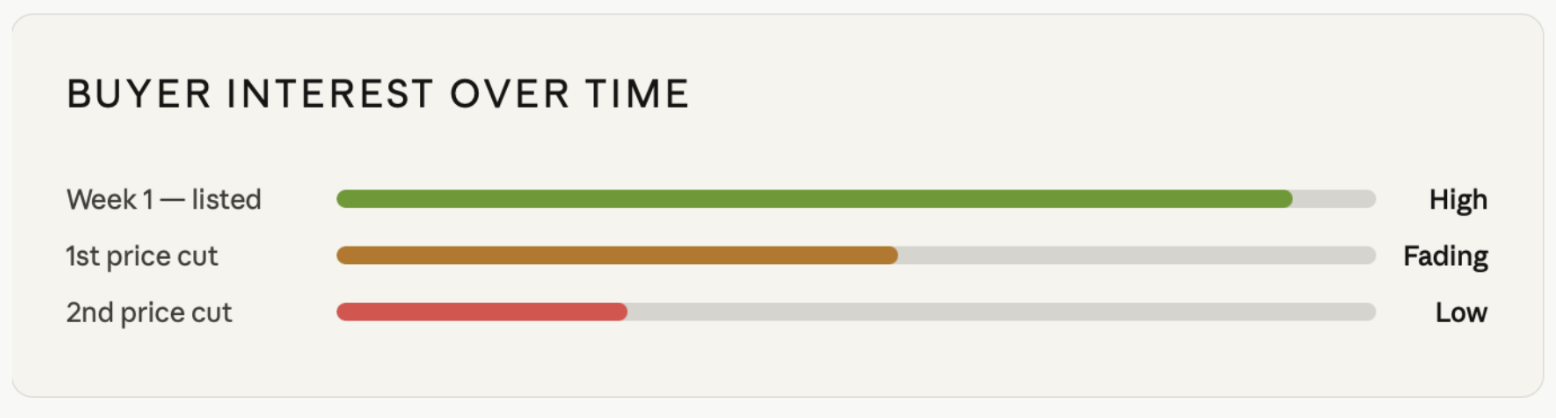
Then come the reductions. Each one sends a signal. The first cut whispers that something is off. The second one shouts it. NAR's Housing Hot Spots 2026 report found that homes priced even slightly above market trigger more days on market and further price reductions. NAR senior economist Nadia Evangelou was direct: "Well-priced homes will stand out in the market immediately." [6]
Days on market matters for another reason too. In 2026, buyers are actively using it as a strategic tool, tracking DOM trends to identify overpriced homes and time their offers for when seller motivation is highest, often right after a price drop. In other words, your price reductions are a signal buyers are waiting for, and they will use it to negotiate you lower.
There is also the psychology of search filters to consider. A home at $449,900 appears in every search set below $450,000. A home at $455,000 misses all of them entirely, invisible to a huge pool of qualified buyers before they have even seen a photo.[7]
Pricing correctly from the start is not about leaving money on the table. In March 2026, roughly 18% of homes still sold above their list price. Those were homes that earned competing offers through perceived value, not inflated asks.[8] Urgency is created by value, not by artificial room to negotiate.
Work with an agent who will show you comparable sales without flattery. Look at what has actually sold in the last 90 days, not what other sellers are hoping to get. Price your home to attract buyers, and let competition do the rest. The goal is not to start high. It is to finish strong.
REFERENCES